
Pahlevāni and Zoorkhaneh Rituals
According to UNESCO, Pahlavāni and Zoorkhaneh (پهلوانی و زورخانه) rituals refer to a long-standing Iranian tradition of athletic, ethical, and ceremonial practice, also known as ‘’varzesh-e pahlavāni’’ ( آیین پهلوانی و زورخانهای, heroic sport) or varzesh-e bāstāni ( ورزش باستانی, ancient sport). In 2010, UNESCO inscribed it on the Representative List of the Intangible Cultural Heritage of Humanity, recognizing it as a living tradition that brings together physical training, music, oral poetry, moral education, and collective identity.
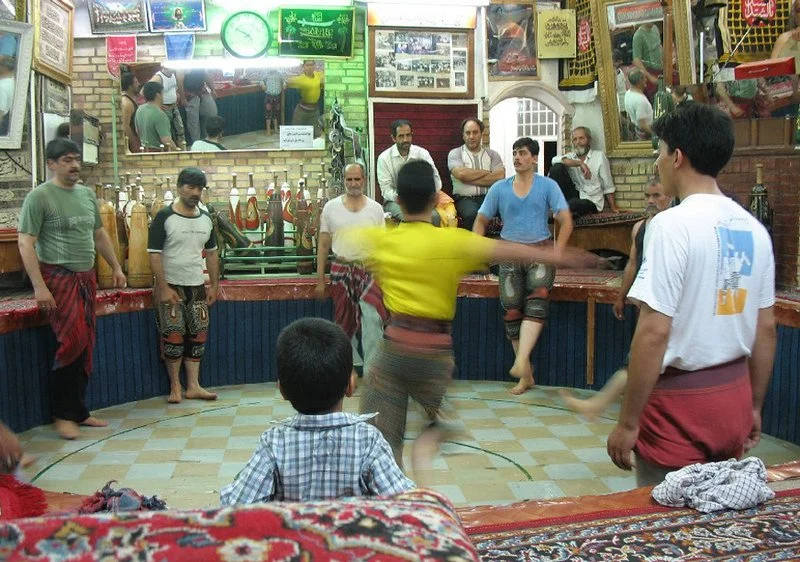
The tradition is practiced in the Zoorkhaneh, literally the “house of strength,” a domed space organized around a sunken training area, which is often polygonal or octagonal in form. Sessions are led by a “morshed” (مرشد, the master), who accompanies the athletes with drum rhythms, chants, bells, and recitations from Persian poetry and epic literature. In this setting, exercise is never merely physical as it becomes an ethical and communal ritual.
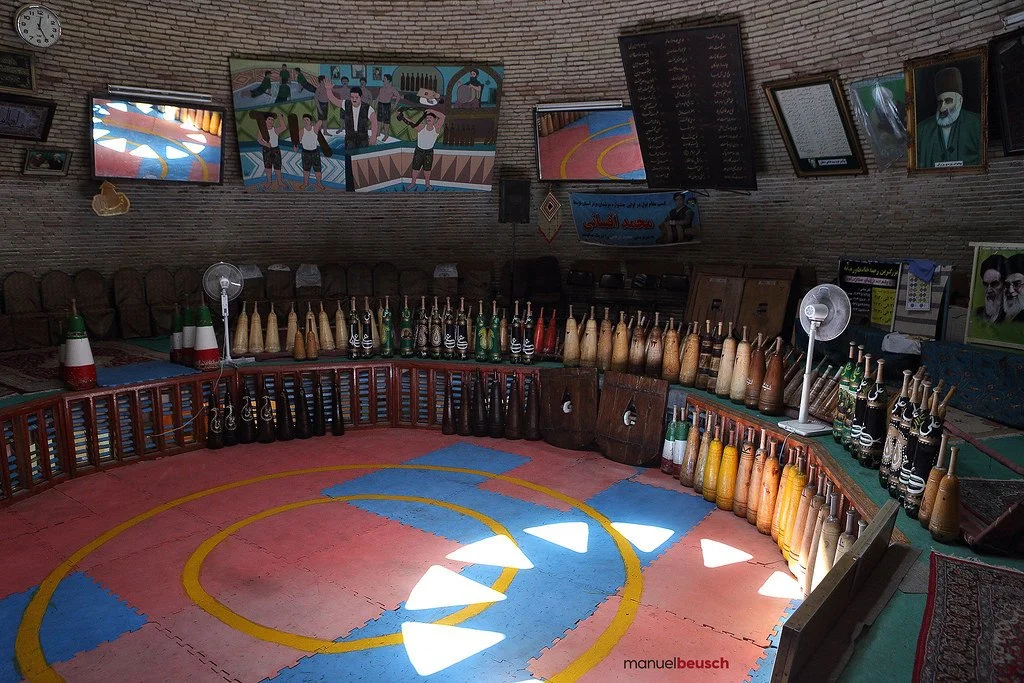
Zoorkhaneh gym, Yazd, Iran. All rights reserved to Manuel Beusch
At the symbolic heart of this tradition stands “Rostam” (رستم), the great hero of “Shāhnāmeh” (شاهنامه, Book of Kings), the Persian national epic completed by Ferdowsi, an ancient Iranian poet, around 1010. Rostam is celebrated as the supreme ‘’pahlavān’’ (پهلوان, champion), a champion whose power is matched by courage, loyalty, and endurance. His legendary feats, including the Seven Labours, made him the enduring model of heroic masculinity in Persian culture. In Zoorkhaneh, the idea of the ‘’pahlavān’’ is shaped not only by athletic ability, but also by the ethical qualities associated with epic heroes, such as Rostam: strength joined to honor, humility, and protection of others.
The connection to Rostam is therefore cultural and symbolic, rather than strictly historical. Zoorkhaneh does not claim that Rostam himself founded the institution; rather, his image and values helped define the ideal toward which athletes aspire. Through recitations from the ‘’Shāhnāmeh’’, heroic memory turns exercise into a continued epic tradition. The athlete is not only building the body, but also stepping into a moral world shaped by legendary examples. This is one of the reasons why the language of ‘’pahlavāni’’ still has athletic, ethical, and heroic connotations.
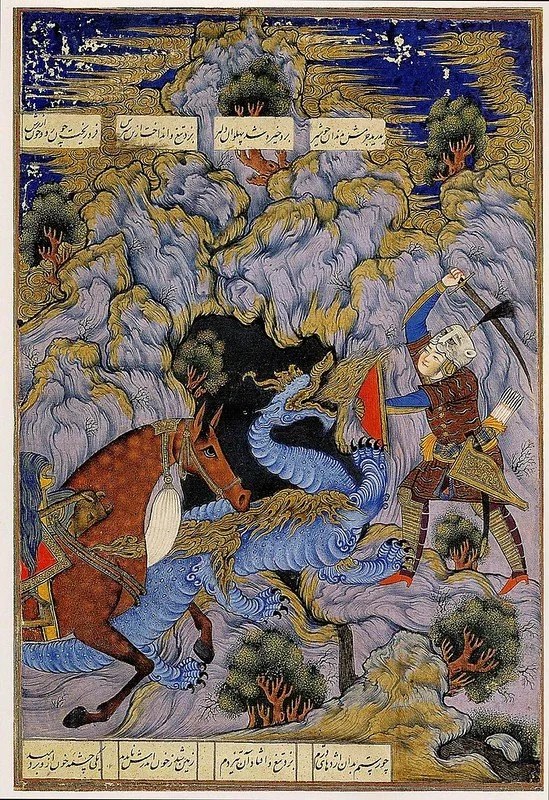
“The Third Battle of Rostam with the Dragon”, illustrated page from a manuscript of the Shahnameh by Ferdowsi, unknown artist, Isfahan, 1648 AH, watercolor, and gold on paper, 28 × 45.5 cm.
All rights reserved to Persian painting.
The origins of the Zoorkhaneh itself are more difficult to trace with certainty. Scholarly sources note that its beginnings are shrouded in mystery, and that while the practice preserves elements that appear ancient, the institution in its recognizable form seems to have developed gradually.
According to Encyclopaedia Iranica, the rituals, terminology, and ethical codes of Zoorkhaneh strongly recall the traditions of ‘’javānmardi’’ (جوانمردی, the courageous youth) and Sufism, even if a direct line of descent cannot be firmly proven. The same source suggests that wrestlers may have formed guild-like communities sometime around the 14th or 15th centuries, adopting ritual forms that later became associated with the Zoorkhaneh.
This layered history helps explain why Zoorkhaneh brings together pre-Islamic heroic memory and post-Islamic ethical ideals. On the one hand, Zoorkhaneh exemplifies the epic world of Rostam and ancient Iranian warrior culture; on the other hand, it also preserves the ideals of humility, brotherhood, discipline, and spiritual self-control. Over time, these strands merged into a single tradition in which physical training was no longer only preparation for combat, but also a form of moral education. In this sense, Zoorkhaneh is both an athletic and a ceremonial space: a place where the body is trained, character is tested, and cultural memory is performed.
Space and Hierarchy
In Zoorkhaneh, space is not simply a setting for exercise, but it is also an essential part of the ritual itself. The architecture, the placement of the participants, and the movement within the arena all express values of discipline, respect, and hierarchy.
At the center of Zoorkhaneh lies the gowd, the sunken exercise pit where athletes perform in a circular formation. This arrangement reflects a clear social and moral order. The ‘’miyāndār’’, (میاندار, the session leader), guides the group from the center, while more senior athletes stand closer to “the morshed” (مرشد), the master who directs the ritual through rhythm, poetry, and instruction. Younger participants are positioned farther away according to their level of experience, with beginners occupying the outermost places. In this way, rank is made visible through space
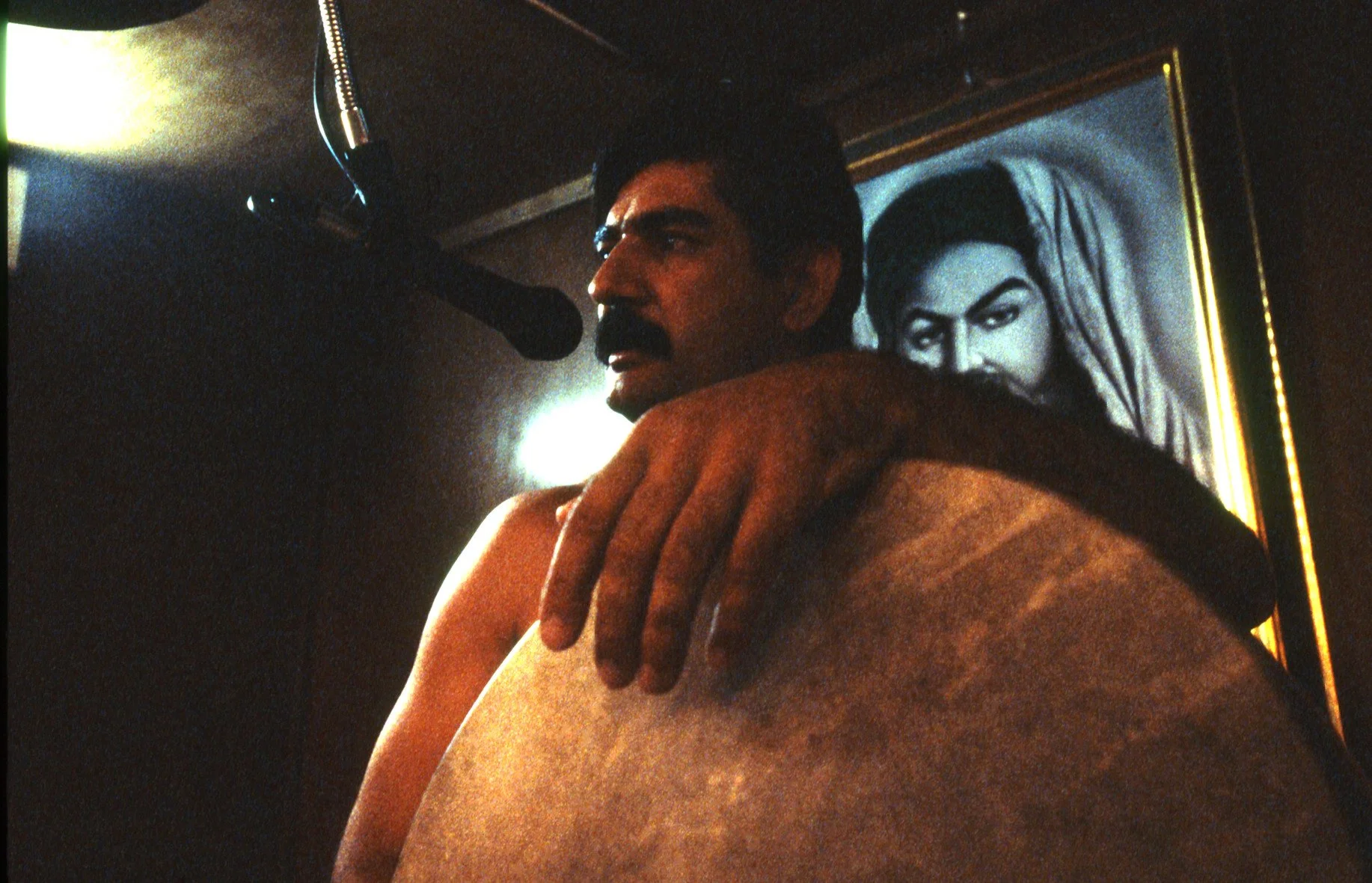
Morshed. All rights reserved to Bergamo Film Meeting.
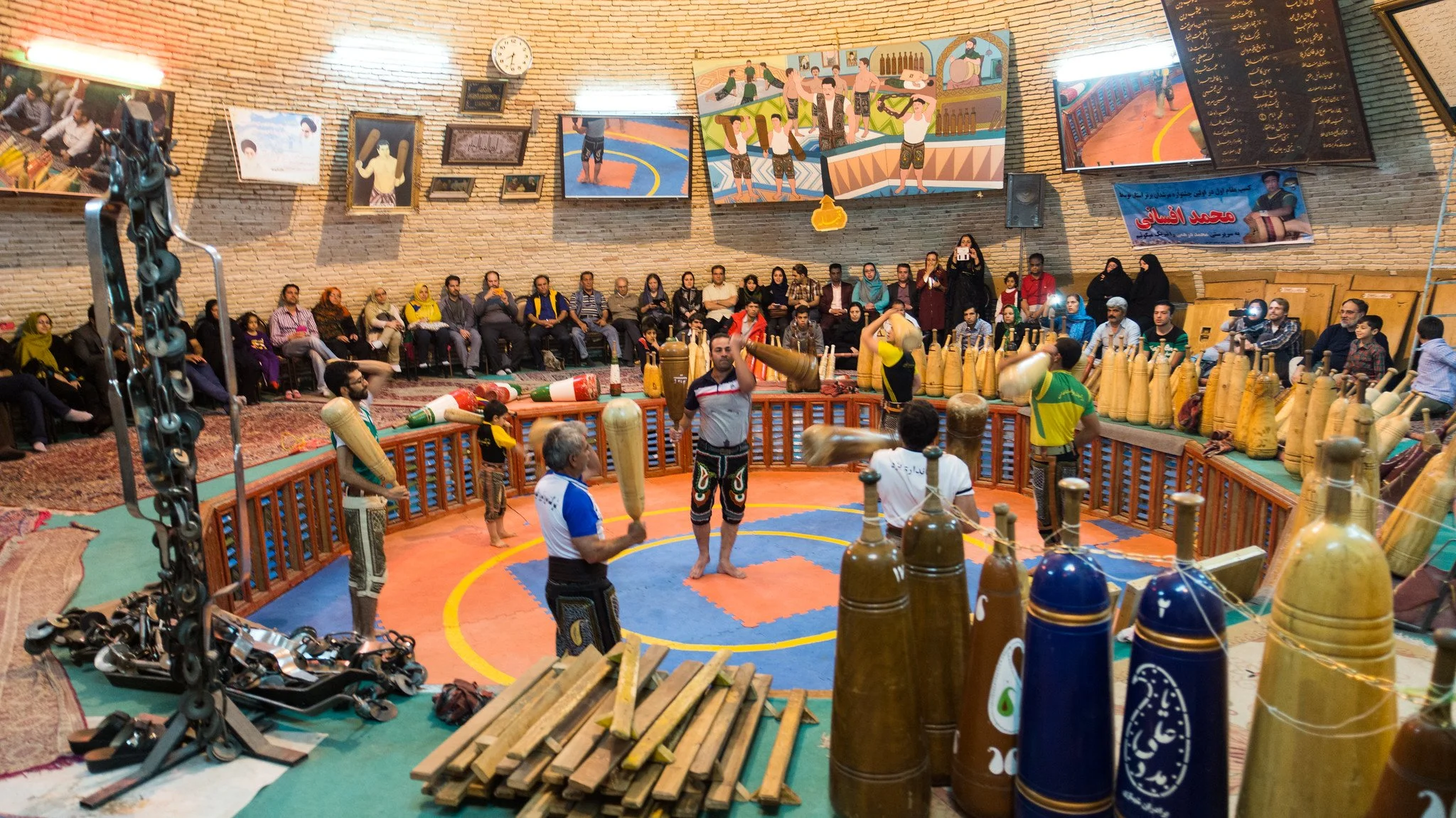
Zoorkhaneh gym. All rights reserved to Stefanos Zachariadis.
The ‘’morshed’s’’ elevated position further reinforces this hierarchy. From his platform, he oversees the training, sets the tempo with the drum, and recites epic or spiritual poetry that gives the exercises a deeper meaning. The “morshed’s” separation from the exercise pit highlights his authority, while the circular arrangement of the athletes emphasizes unity within an ordered structure.
The architecture of the Zoorkhaneh also carries symbolic meaning. Traditionally, the entrance is low, requiring visitors to bow as they enter, a gesture of humility and respect. This simple act reflects one of the central ideals of Zoorkhaneh: physical strength must be accompanied by modesty, discipline, and moral character.
For this reason, Zoorkhaneh is more than a kind of sport. It is a carefully organized space where architecture, ritual, and movement come together to teach values as much as techniques. Through its spatial order, Zoorkhaneh preserves a vision of strength rooted in respect, seniority, and community.
From Epic Hero to Moral Exemplar
Shaped by the legacy of Persian epic literature, the ideal of the ‘’pahlavān’’ (پهلوان, champion) was never defined by physical strength alone. In the figure of Rostam (رستم), heroic power is inseparable from endurance, loyalty, courage, and a sense of duty. He is not merely a victorious warrior, but a model of character formed through trial, sacrifice, and responsibility.
Within the later culture of Pahlevāni (پهلوانی) is epic ideal was gradually reinterpreted through ethical and spiritual values. The athlete was no longer admired simply for defeating an opponent, but for embodying the virtues of ‘’javānmardi’’ (جوانمردی, the courageous youth): humility, self-discipline, generosity, and service to others. In this way, the ‘’pahlavān’’ (پهلوان) represents more than physical strength, as he also is a symbol of the moral exemplar who is expected to protect the weak, respect the community, and unite strength with integrity.
This fusion of heroic memory and ethical discipline is one of the reasons why the tradition continues to hold such cultural significance today. In Zoorkhaneh, physical training is inseparable from moral formation: the athlete becomes a custodian of values.
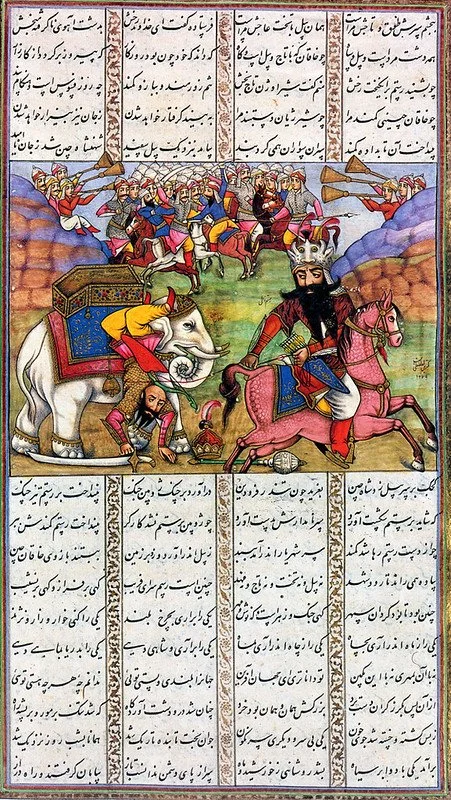
Rostam pulls the Khagan of Chin from his saddle, signed by Āqā Loṭf-ʿAli Ṣuratgar, dated 1279/1862-63, from the Šāh-nāma-ye Dāvari, Reżā ʿAbbāsi Museum, Tehran.
All rights reserved to Persian painting.
Modern Transformation and Contemporary Practice
Encyclopaedia Iranica notes that interest in Zoorkhaneh grew significantly after the millenary celebrations of Ferdowsi in 1934, when epic Persian culture was elevated as a key component of modern Iranian national identity. By the late 1930s, the term varzesh-e bāstāni (ورزش باستانی, ancient sport) had become more widely used, emphasizing the tradition’s connection to a glorified premodern and heroic past.
This process continued through state-sponsored spectacle and mass media. Encyclopaedia Iranica records that in 1939, when Crown Prince Mohammad Reza married Princess Fawzia of Egypt, public celebrations included exhibitions of “varzesh-e bāstāni’’ as part of large gymnastic displays in Tehran’s main stadium. A few years later, in 1941, Radio Iran began broadcasting Zoorkhaneh music and poetry in the mornings, allowing listeners to practice club-swinging exercises at home and extending the sound of Zoorkhaneh beyond the walls of the gymnasium itself. These developments helped turn what had once been primarily a local, guild-like, urban institution into a more visible symbol of national culture.
Modernization, however, did not only increase visibility; it also changed the internal life of the tradition. As older systems of rank and apprenticeship gave way to more standardized teaching and organized sport structures, Zoorkhaneh increasingly had to negotiate between ritual heritage and modern athletic culture. UNESCO’s description still emphasizes the traditional structure of transmission, through the ‘’morshed’’ (مرشد, the master), the ‘’pīshkesvat’’ (پیشکسوت, senior member), oral poetry, and embodied instruction, but the practice now exists in dialogue with federations, heritage institutions, public performances, and cultural diplomacy.
Today, the tradition continues in Iran both as a living local practice and as a recognized form of national heritage. UNESCO notes that participants may come from different social or religious backgrounds and that local groups often maintain strong ties to their communities, including ideals of service and assistance to others. A related cultural description states that there are hundreds of Zoorkhaneh across Iran, showing that the practice remains institutionally present even while its social role has evolved.
At the same time, contemporary practice is shaped by new questions of visibility, inclusion, and reinterpretation. Recent scholarship and reporting show that women have increasingly sought access to Pahlevāni training and recognition within a tradition historically defined as male. This does not mean that the gender boundaries of Zoorkhaneh have disappeared; rather, contemporary debates reveal how the meaning of the ‘’pahlavān’’ (پهلوان, the champion) continues to be reimagined in the present.
The tradition also now circulates beyond Iran through international organizations and diaspora communities. The International Zoorkhaneh Sports Federation presents the discipline as a global sport and cultural practice, while UNESCO frames it as a form of intangible heritage transmitted through performance, instruction, and community life. In diaspora settings, Zoorkhaneh practice often takes on an additional role: it becomes a way of preserving Persian language, poetry, memory, and Iranian cultural diaspora.
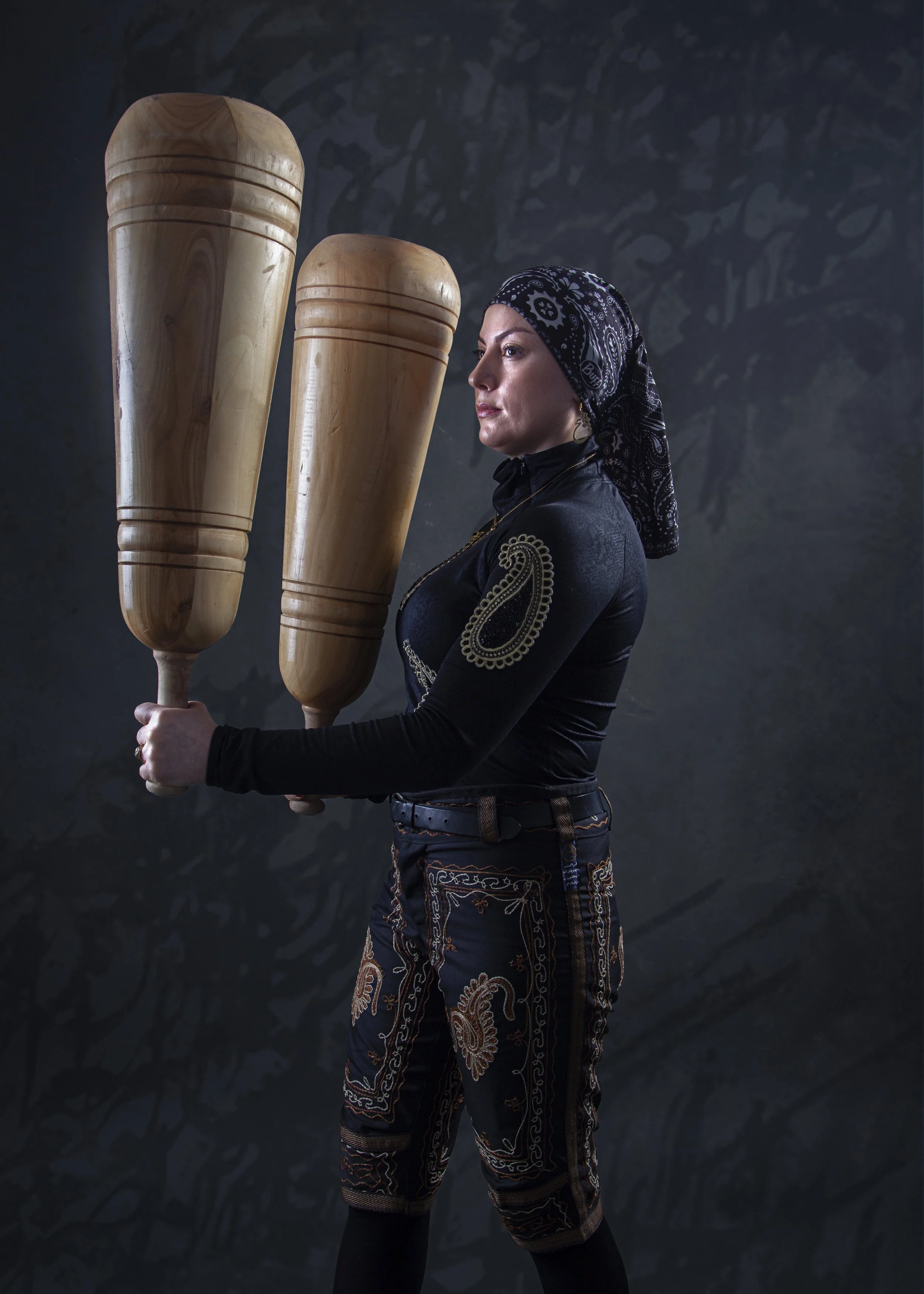
Farnoush Djavaheripour, as photographed by Mahsa Alikhani.
Instruments
The physical culture of Zoorkhaneh is shaped by a small set of distinctive training tools, each associated with strength, control, and ritual discipline. Of the many implements once used in this tradition, four remain central today: the mil (میل, Indian clubs), the kabadeh (کباده, iron bow), the sang (سنگ, wooden shields), and the takht-e shena (تخته شنا, push-up board). UNESCO describes these objects as instruments that symbolically evoke ancient weapons, linking athletic training to older ideals of heroism and martial readiness.
-
consists of a pair of large wooden clubs, traditionally swung in broad, circular motions that strengthen the shoulders, arms, chest, and coordination. Their size and weight can vary considerably, allowing athletes of different levels to train with increasing resistance. The exercise demands not only strength, but also rhythm and balance since the clubs must move in harmony with the cadence set by the “morshed”(مرشد, the master). Sources about Zoorkhaneh tradition commonly connect the mil to the memory of ancient war clubs or maces, showing how athletic movement preserves a martial symbolism.
-
is a heavy iron bow fitted with chains or metal rings and swung from side to side above the head and shoulders. Its form recalls the bow, but in practice, it functions as a demanding resistance instrument that strengthens the upper body while training endurance and precision. Performed correctly, ‘’kabadeh’’ combines force with control: the athlete must sustain a smooth arc of motion without losing posture or rhythm. UNESCO’s description of the practice of Zoorkhaneh confirms that these tools are just kinds of equipment, but they are also symbolic extensions of earlier weapon traditions.
-
is made up of two large wooden boards, often shield-shaped, which the athlete lifts while lying on his back. This exercise places emphasis on the chest, arms, and shoulder girdle, but also on breathing and tempo. Because “the sang” is worked in pairs, it requires symmetry and concentration as much as pure strength. Its resemblance to shields reinforces the broader logic of the Zoorkhaneh, where bodily training is inseparable from the memory of combat, discipline, and ceremonial form.
-
is a small wooden plank used as a support for different forms of push-ups and bodyweight exercises. Compared with the heavier implements, it appears simple, yet it plays a fundamental role in building stamina, mobility, and technical control. It belongs to the calisthenic side of Zoorkhaneh, where the body itself becomes the principal instrument of training.
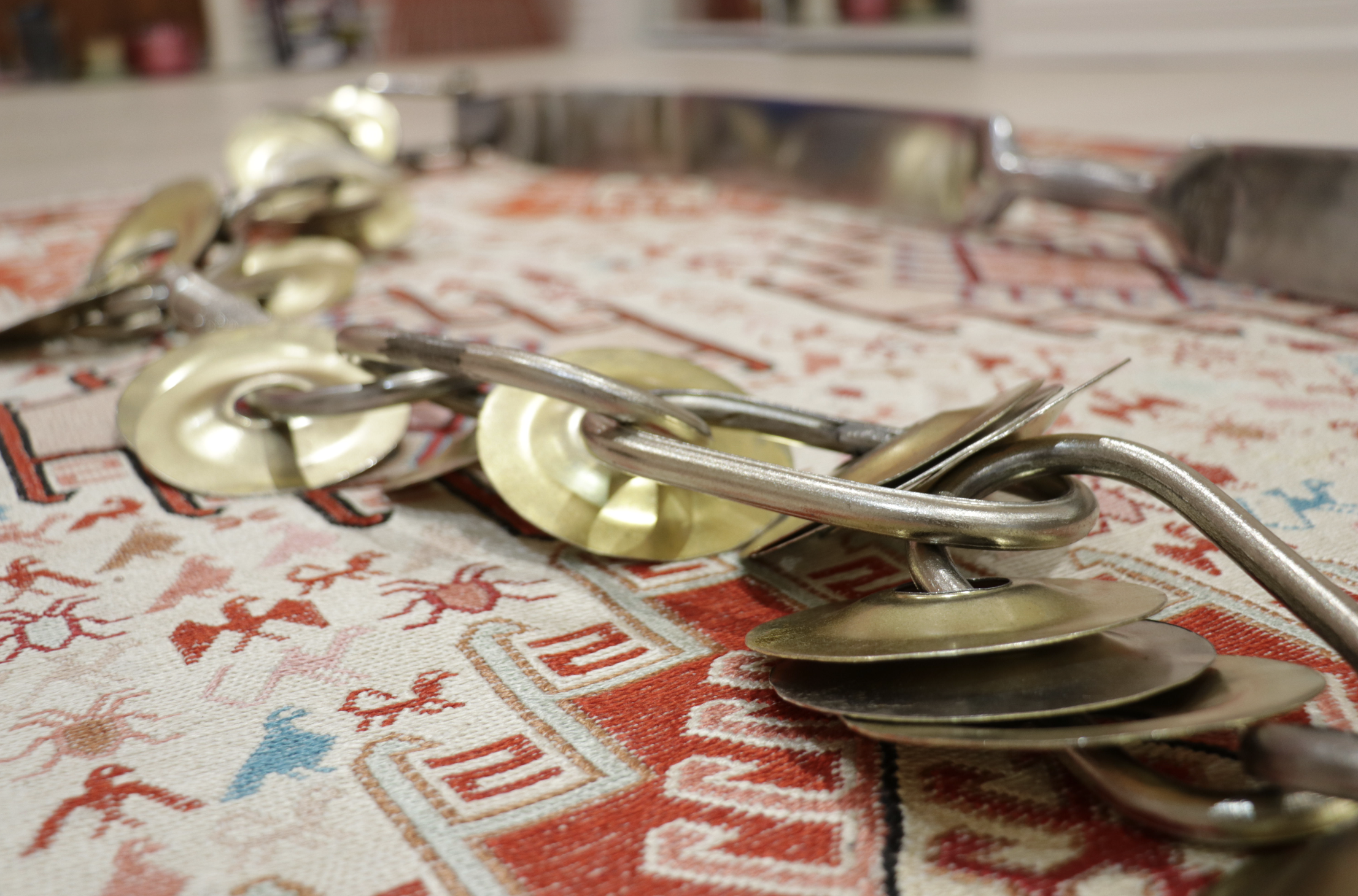
Kabadeh
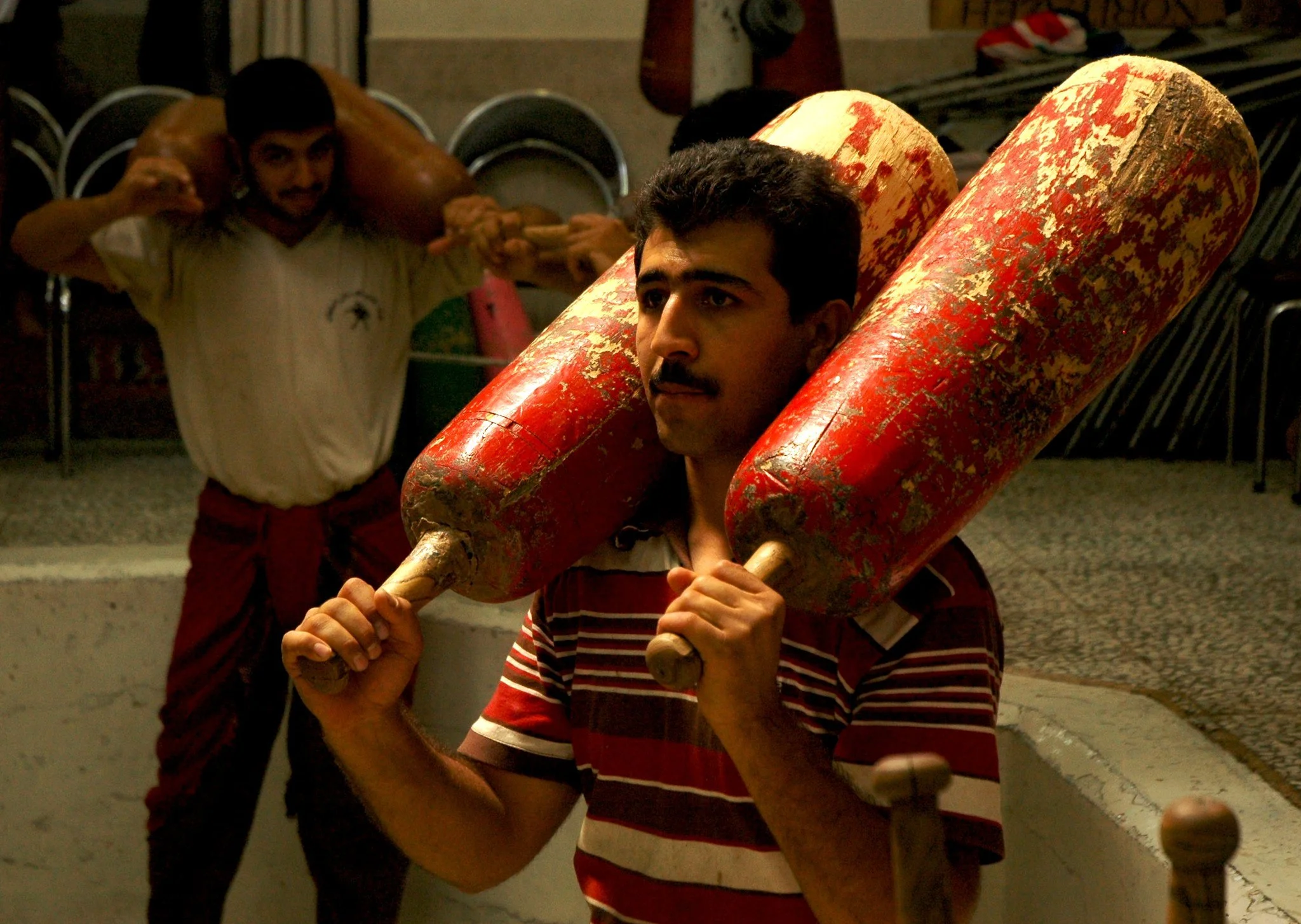
Mils. All rights reserved to hannu.oskala.
Charkh. All rights reserved to Ondřej Š.
Not all Zoorkhaneh exercises require equipment. Alongside working with the necessary tools, athletes also perform a series of rhythmic warm-up and conditioning movements designed to develop endurance, agility, and flexibility. Among the most striking is the ‘’charkh’’ (چرخ, rotation), a rotating exercise in which the athlete spins with speed and composure, transforming repetition into a display of balance, concentration, and grace. Like the use of the training tools, these movements are performed in time with the drum and voice of “the morshed,” (مرشد, the master) whose guidance turns physical exercise into a coordinated ritual.
Taken together, these implements reveal that Zoorkhaneh is far more than a gymnasium. Its tools are functional, but they are also deeply symbolic: they train the body while preserving a cultural memory of warfare, ethical discipline, and collective performance. In Zoorkhaneh, strength is never presented as brute force alone, but as something shaped by rhythm, self-mastery, and tradition.
Philosophy
-
At the heart of Pahlevāni lies the concept of “javānmardi” (جوانمردی, the courageous youth) often translated as chivalry, noble-mindedness, or moral courage. According to Encyclopaedia Iranica, ‘’javānmardi’’ refers to an ethical system marked by altruism, magnanimity, and loyalty. In the context of Zoorkhaneh, this means that strength must be guided by humility, generosity, and responsibility toward others.
-
A ‘’pahlavān’’ (پهلوان, champion) is not simply a strong athlete or a winner in competition. In the Pahlevāni tradition, the true ‘’pahlavān’’ is someone whose physical discipline is matched by inner discipline. He is expected to help the weak, respect others, practice self-restraint, and use strength in the service of justice rather than ego. UNESCO also presents the tradition as one in which advancement depends not only on physical mastery but also on moral formation and respect for communal hierarchy and values.
-
One of the most important dimensions of this philosophy is generosity. Zoorkhaneh traditionally cultivated not just powerful bodies, but socially responsible people. The ideal athlete was someone who gave back to the community, protected dignity, practiced hospitality, and carried strength with compassion. This ethical expectation is one of the clearest distinctions between being a mere champion and being a true ‘’pahlavān.’’
-
The philosophy of Pahlevāni also insists that true strength begins with self-mastery. The ritual setting of Zoorkhaneh, with its music, coordinated movement, poetic recitation, and hierarchy of learning, teaches discipline, patience, and respect. Athletes are trained to control not only the body, but also pride, aggression, and selfishness. In this sense, Zoorkhaneh is both a place of exercise and a catalyst for character formation.